

Book recommendations from members of Congress
Previously published in The Hill, a year-end reading list from Capitol Hill that reveals how books continue to shape judgment, values, and common ground across party lines.

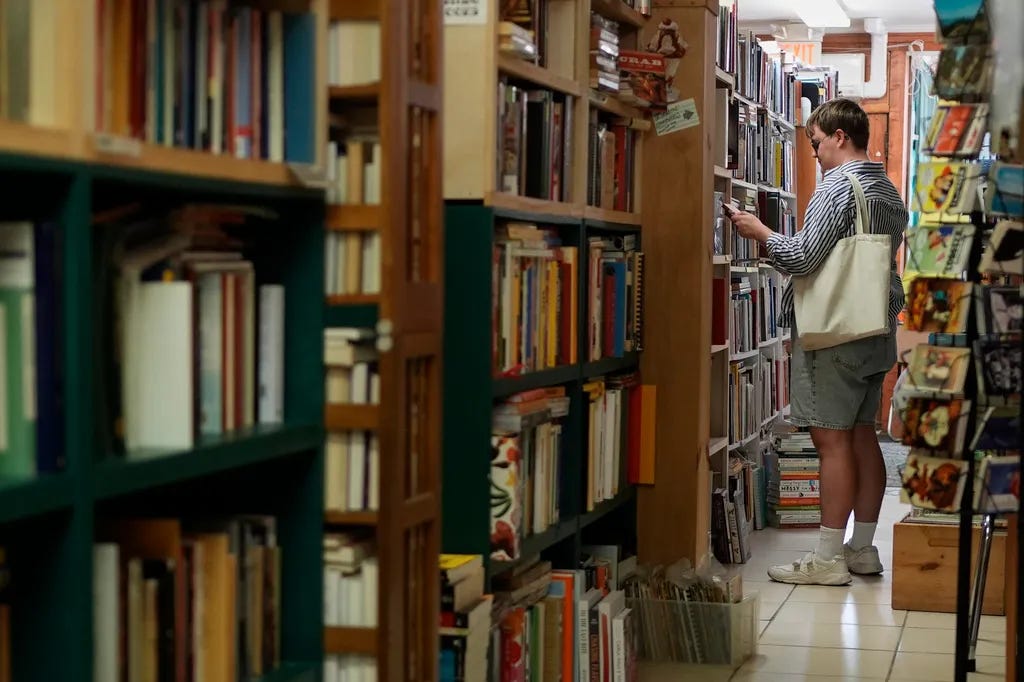
A customer shops at the Green Hand Bookstore in Portland, Maine, on Thursday, Aug. 7, 2025. (AP Photo/Robert F. Bukaty)
As an independent bookstore owner, one of my favorite New Year’s projects is asking key members of Congress to share the most influential books they’ve read during the year. It’s a heartening effort, reminding me that books provide some bipartisan connectivity; and that in an age of algorithms and AI, our policymakers continue to rely on real books to influence their judgements. Here, lightly edited for brevity, are this year’s top selections.
Sen. Ron Wyden (D-Ore.): “‘A Woman of No Importance: The Untold Story of the American Spy Who Helped Win World War II.’ The Nazis were petrified of this gutsy spy, and she’s a portrait of individual bravery, relentlessly determined to defeat evil. Extra bonus, the book shows character is more important now than ever.”
Rep. Elise Stefanik (R-N.Y.): “As a mom, I’m very deep in the wonderful world of children’s books as we work to instill the importance of literacy and love of reading to our four-year-old son Sam. Some children’s books I highly recommend for parents to consider: ‘How Do Apples Grow?’ by Jill McDonald, ‘What the Road Said’ by Cleo Wade, ‘Nesting’ by Henry Cole, ‘Owl Babies’ by Martin Waddell, ‘Happy Birthday Moon’ by Frank Asch, and ‘Grandpa’s Tractor’ by Michael Garland. We’re very discerning when it comes to illustrations and prefer the beautiful artistry of illustrators rather than the overly graphic AI designs that are creeping into children’s books. The power and love of reading and imagination is among life’s greatest gifts. You can follow our family’s reads with Sam on Instagram.”
Rep. Jamie Raskin (D-Md.): “It’s a tie for #1: Zaakir Tameez’s remarkable biography, ‘Charles Sumner: Conscience of a Nation,’ tells the story I never knew, of how passionate abolitionist Charles Sumner, who hated politics and politicians, ended up in the U.S. Senate from Massachusetts in the first place and then came to be violently assaulted on the Senate floor by South Carolina Rep. Preston Brooks. It then follows Summer’s difficult convalescence and the central role he played in the coming of the Civil War and everything to follow. Absolutely riveting.
“The other book I loved was ‘Doppelganger: A Journey into the Mirror World,’ Naomi Klein’s dazzling meditation on conspiracy theory, fake news and intertwined streams of extremist politics in the Internet age. Obsessively interesting and provocative.”
Rep. Tom Cole (R-Okla.): “‘Churchill’s Citadel: Chartwell and the Gatherings Before the Storm’ by Katherine Carter. No one lived life better than Winston Churchill. Carter shows how Churchill used his wilderness years to prepare for the coming trials of the Second World War.”
Rep. Rosa DeLauro (D-Conn.): “While people may have their opinions, Walter Isaacson’s ‘The Greatest Sentence Ever Written’ goes word by word of the second sentence of The Declaration of Independence, which lays out the singular vision and guiding philosophy of our founding fathers, when they decided to create a free nation from a tyrannical king. Though I do wish they had remembered the ladies! As we approach the United States’ 250th anniversary, it is the sentence that I continue to find hope in for our country and our democracy, as we strive to achieve common grounds, truths, rights, and aspirations.”
Rep. French Hill (R-Ark.): “‘Secret History of the Five Eyes’ by Richard Kerbaj. New in 2025, this book provides tremendous insight in the historic relationships between the United States and its English partners in espionage. It provides great context on the mutual benefits of intelligence sharing between longtime allies. As a member of the House Permanent Select Committee on Intelligence, I found it quite good in providing historic context and outlining early strengths and weaknesses of the services of each of the partner nations.”
Rep. Susan Bonamici (D-Ore.): “‘Your Brain on Art: How the Arts Transform Us.’ This is a fascinating book by Susan Magasmen and Ivy Ross. I’m an avid supporter of arts education because it helps students become confident, creative, critical thinkers, and I support the arts and culture in society because they can connect communities, grow the economy, and bring us joy. This book introduces the reader to neuroaesthetics, which is the study of how the brain and the body respond positively to the arts. There is convincing scientific evidence that the arts heal, and this book explains why. ‘Your Brain on Art’ truly makes the case for more arts in schools and everywhere!”
Rep. Sharice Davids (D-Kan.): “‘Merchants of Grain’ by Dan Morgan may be decades old, but its lessons feel urgent in 2025. It shows how global shocks or market instability can create real risks for our fragile supply chains — insights that guide my work in Congress to strengthen food security, support farmers, lower grocery prices, and protect America’s food supply.”
I am no longer a member of Congress, but I’m going to exercise editorial prerogative and throw in Maggie O’Farrell’s “Hamnet.” It centers on the family of William Shakespeare, brilliantly using historic, perhaps inventive fiction to guide us through the nature of grief, loss and resilience. Forgive the cliché, but I could not put it down.

Thanks for reading Rep. Steve Israel on Books and Politics! Subscribe for free to receive new posts and support my work.